 Kindred Lights
The substance was an answer to a real question. Understanding the question is where the real work begins — and where the Five Steps go.
A glass of wine with dinner. Beers at the game. Celebrating, socializing, unwinding. For most people it stays there — pleasant, occasional, unremarkable.
But for some people it becomes something else. Something that feels necessary rather than optional. Something that creeps from the edges of life toward the center. And the question nobody asks — the one that actually matters — is why.
Not why you lack willpower. But what the substance was doing for you that nothing else could do.
Whether it's wine at the end of the day, prescription pills that became necessary, or something the culture names more harshly — the mechanism is the same. Almost always, underneath an addiction that got out of hand, there is a charge that predated it. A grief that never got witnessed. A trauma the nervous system absorbed and never fully processed.
It might be obvious in hindsight. Or it might be invisible — the way second-hand trauma is invisible. The ER nurse who saw too much. The imaging tech who spent twenty years witnessing suffering and never once called it trauma because he was just doing his job.
The substance was an answer to a real question. Understanding the question is where the work begins.
Sir EgoYour ego. The hero with the wrong map. didn't see a problem because there wasn't one yet.
The drinking was social, celebratory, normal. Everyone around him was doing it. The culture endorsed it, the occasions called for it, and honestly — it worked. The edges softened. The voltage turned down. Something resembling ease arrived that wasn't available any other way.
His script: this is just how people relax. This is my reward. This is how I handle stress. I'm fine — look at everything I'm still managing.
And for a while, that script was accurate enough. The substance was doing what it was supposed to do — regulating a nervous system that was carrying more than it could process through any other means.
The problem arrived quietly. The amount that worked last year doesn't work this year. The occasions that justified it keep expanding. The line between choice and necessity blurs so gradually that Sir Ego genuinely doesn't notice when he crosses it.
By the time it's visible as a problem, the substance has reorganized around a charge that was there long before the first drink. Sir Ego wasn't weak. He was carrying something real, with the only tool that seemed to reach it.
Sir Ego's script says: I can stop whenever I want. I just don't want to right now.
Until the day he discovers that's no longer true. That quiet recognition — the moment Sir Ego finally meets it honestly — is the collision point.
The Script of CreationThe living intelligence running the universe. has been running the voltage deliberately. The pressure, the dysregulation, the charge underneath the substance — these were never random. The KarmariculumYour soul's custom lesson plan. designed the specific conditions that made the substance necessary, because those same conditions contain the curriculum this soul came here to complete.
The floor — whenever and however it arrives — is the opening the Karmariculum has been building toward. Precisely calibrated. Exactly the temperature required, nothing more.
Sir Ego didn't fail. His strategy ran its course. And when a strategy runs its course completely, something else becomes possible.
I didn't think I had a drinking problem. I thought I had a life problem.
The grief I never processed after my mother died. The marriage that was dismantling my reality. The custody battle. The supervised visits. The financial collapse. Each one added to a closet full of monsters that hovered around me all day — shapeless, relentless, waiting.
The first sip made them recede. The second pushed them further back. By the third or fourth they were almost out of sight. And that — that specific relief, that specific quiet — was worth more than I can describe to someone who hasn't felt it.
The problem wasn't the drinking. The problem was that stopping meant they came back.
That's why you drink until you black out. Not to destroy yourself. To keep the closet door shut one more night.
Three DUIs. The third one I could not hide.
I woke up on the floor of a holding cell. The monsters were there. There was nowhere left to go.
Something unexpected happened in that cellblock.
I started paying attention to the women around me. Every one of them had been carrying charges since childhood — so old and so unnamed they had never once had a name for them. Just the substance. Just the relief. Just the door staying shut one more night.
Something opened in my chest that I had never felt before. Clean. Unearned. Compassion that didn't need a personal stake to arrive.
I walked out of a jail floor and into a life that began to rebuild itself faster than I could account for, in ways that surprised me and continued to surprise me, on a timeline that was the karmariculum's, not mine.
The Wise OneYour higher self. Already home. is closest when Sir Ego has run out of ideas. The opening the karmariculum has been arranging becomes available the moment the old strategy has nothing left.
Twenty years of sobriety.
The monsters faded slowly, as monsters do when they are witnessed instead of fled. But the Five Steps gave me something the substance never could — a way to open the closet door on purpose, feel what was inside, and watch it lose its power. One trigger at a time. One release at a time.
The closet is mostly empty now. What's left has grown quiet.
The custody battle, the jail floor, the man who orchestrated my destruction — I watched him make gravy at my son's Thanksgiving table last year.
That is what becomes possible when the monsters finally get felt rather than managed.
A quick word about the aspects.
These eight — Light, Peace, Calm, Wisdom, Love, Power, Joy, and Expression — are the actual substance of who you are. They are not qualities to achieve. They are qualities to remember. What your soul is made of, at the level Sir Ego cannot reach.
And here is the clean distinction between Sir Ego and the Wise One:
Sir Ego runs each aspect through its distorted, either/or polarity. The Sword or the Shield. The two exhausted ends of the same rope. Whichever pole his script is running today.
The Wise One embodies the exalted version. The aspect at its unpolarized center — available without effort, radiating without performance. The real thing.
The karmariculum is exquisitely specific. It forges the specific aspects your soul came here to embody, through the precise pressure required. Nothing extra. Nothing wasted. The full teaching is in the Truth Room →
The specific pressure of this terrain is forging specific aspects of your soul. The trigger is the invitation, not the evidence against you.
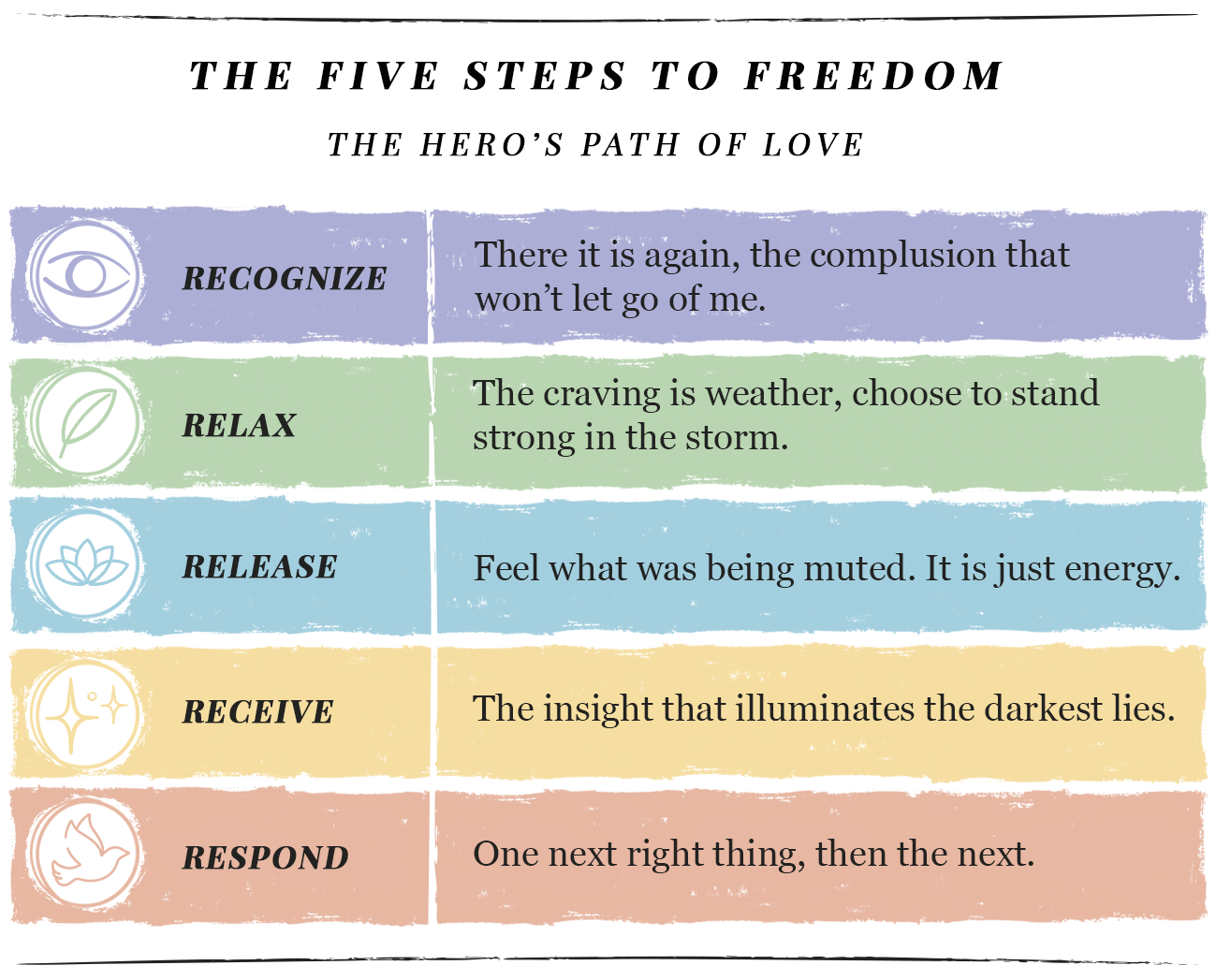
Here is what the practice looks like, mapped to this particular terrain. The same five movements, in language that meets the addiction's specific weather.
The Five Steps work alongside professional support — they address the root, but they don't replace the help that's available right now. If you are in active addiction or on the edge of relapse, please reach out.
SAMHSA National Helpline — 1-800-662-4357 — free, confidential, 24/7
Crisis Text Line — text HOME to 741741
AA Meeting Finder — aa.org
Something happened before the first drink.
A loss. A grief that never got witnessed. A closet full of monsters that nobody helped you name. And a substance that, for a while, kept them quiet.
That wasn't weakness. That was a nervous system doing what nervous systems do — finding the one thing that worked, and holding on.
And underneath the craving — underneath all of it — was something the substance could only borrow: the divine joy that is your soul's actual nature. The intensity of that longing was never about the drink. It was about God. About home. About the radiant essence you came here already carrying.
The floor is grace, precisely calibrated. The opening your Karmariculum has been building toward — the one place where real work could begin.
These are the souls trying hardest to get home. The truth runs the opposite direction.
The closet can open. What's inside has always been smaller than what's on the other side of feeling it.
The Wise One was on that jail floor. She walked the road that came after — proof that she is closest when Sir Ego has finally run out of ideas.
You were never the cautionary tale.
You were always the proof of concept.
Something in your story has a name. A specific aspect, a specific script, a specific place where the charge is ready to move. The Trigger Decoder can help you find it — in five minutes, in two sentences, for free.
Try the Trigger Decoder ✦These questions arrive often from readers walking the addiction terrain — for themselves, for someone they love, or both. Each answer comes from the framework's voice. If any of these open a doorway, the path goes deeper than the answer alone.
You search this phrase at 11pm. You read the lists. You measure yourself against the criteria. You count drinks. You note exceptions. You build a case for and against. And underneath the searching is a quiet question Sir Ego has been trying to drown out for a long time: am I in trouble?
The fact that you are asking this question is information. People who have an easy relationship with substances rarely search this phrase. The asking itself is the part of you who has been knowing what is true for a while, finally getting loud enough to be heard. The Wise One in you has been quietly tracking the relationship with the substance long before Sir Ego was ready to acknowledge what she was seeing.
The clinical checklists are useful. They will give you language for what is happening. They will not tell you the structural truth, which is that addiction is whatever has captured your soul's attention so completely that the substance now sits between you and your own karmariculum. The threshold has nothing to do with how many drinks per week or whether you can go three days without. The threshold is whether the substance has begun to organize your life around its own continuation.
The Wise One in you has been at peace with the substance's absence the whole time. She has had no relationship with it. She has been with the part of you who was using and the part of you who has been wondering, holding both with equal love, knowing the curriculum is bringing this conversation to the surface for a reason. The asking is the curriculum's invitation. She has been waiting to be heard.
✦ What if the part of you who has been quietly knowing the answer is the part who has been waiting for you to ask the question?
You quit on Monday. You make it through Tuesday. By Friday night something has shifted, and by Saturday morning you are using again, and the weight of the cycle has its own shame underneath the using. You have tried willpower. You have tried distraction. You have tried promises to yourself, to people you love, to whatever versions of God you have access to. And the cycle keeps closing back on itself.
The willpower posture has been treating addiction as a battle of strength. Strength is a quality of Sir Ego, and Sir Ego is the one running the script that defends the next use. When the battlefield is Sir Ego against Sir Ego, the substance always wins, because it is structurally on Sir Ego's side. The script that defends the next drink is louder than the script that resolves to stop, because the defending script has been getting daily reinforcement and the resolving script gets reinforced briefly and then drowned out.
The relapse is information, not failure. It is information about which layer of the work has been completed and which layer is still ahead. Each round of sobriety builds something that the previous round built. Each relapse surfaces material that needed to be seen. The cycle is, in a way nobody is comfortable saying, part of the curriculum's design. The soul is being walked through something that requires multiple passes.
The Wise One in you has been steady through every cycle. She has watched Sir Ego try and fail and try again, holding him with the same love regardless of which round he is on, knowing the work is being done at a layer he cannot yet feel. The way out of the cycle eventually opens, when the work has matured enough that the substance is approached from her seat rather than from his battlefield. She has no battle to fight, because she has no relationship with the substance to begin with. From her seat, the cycle has a different ending.
✦ What if the part of you who has been steady through every cycle has been doing the actual work, while Sir Ego was busy keeping score?
You did not arrive in this terrain by accident. The standard explanations — genetics, environment, trauma, peer influence — are real and incomplete. They describe the surface mechanics. The deeper question is what your soul was actually seeking when it reached for the substance, and the answer is more interesting than the standard frameworks let it be.
The substance briefly produced a quality of experience your soul has been seeking for a long time. Quiet. Release. Joy. Connection. The dropping of the relentless interior weather. A taste of something that felt, even for an evening, like home. Sir Ego, who has been managing your life with whatever tools were available, found a tool that briefly gave him a glimpse of what the soul was actually looking for. He kept reaching for it because the glimpse was real, even though the path he was on for finding it was the wrong path.
Underneath the addiction, often, are layers that need to be honored — early trauma, sustained childhood pain, sensory and emotional overwhelm that the empath nervous system was unequipped to process, second-hand trauma, abuse, complex PTSD, a thousand specific configurations the body was carrying without anywhere to put. The substance was the only thing that worked at the volume the overwhelm required. The self-medication was real. It was also incomplete, because while the substance was suppressing the overwhelm, it was also suppressing the karmariculum's work to address what had created the overwhelm in the first place.
And — gently, because this teaching can be misread if held wrong — many addicts are souls with a higher-than-average call to joy who have been searching for the divine and finding glimpses of it in the wrong places. The substance is the closest thing the ego has been able to find that resembles the home the soul is seeking. The intensity of the seeking is information about the depth of the call. Souls who walk this terrain are often serious souls on serious assignment. The terrain itself, when walked through, often opens onto the path the seeking was actually for.
The Wise One in you is the home you have been seeking. She has been here the whole time, holding everything Sir Ego has been trying to manage with the substance, holding the trauma and the overwhelm and the call to joy and the call to God all at once, knowing the substance was a near-miss that pointed in the right direction even as it took you the wrong way.
✦ What if the home you have been searching for in the substance has been quietly held by the part of you who has been with you all along?
You did the work. You stayed sober. You rebuilt your life. And then, sometimes after a stretch long enough that you thought you had crossed into safety, the substance came back. The shame of that return often outweighs the shame of the original addiction, because the relapse seems to mean the whole previous round was wasted.
It was not wasted. The previous sobriety was real. The work that was done in that period — the rebuilding, the relationships, the inner shifts — has remained part of you. Relapse does not undo what was built. It surfaces a layer of the work that the previous round was not yet ready to address.
Often the layer that surfaces is something the previous sobriety was not yet equipped to face. A grief that had been held at bay. A relationship pattern that needed to break. A trauma that the nervous system could only access once it had stabilized enough to hold it. The relapse, painful as it is, is also information that the curriculum is now ready to deliver something that requires more than the previous sobriety could provide. The next round of sobriety, when it begins, will build on everything the previous round established and will go to a layer the previous round could not reach.
The Wise One in you has been steady through every round. She has been with the early sobriety, the long sobriety, the relapse, and the next beginning. She has been at peace with the cycle, knowing each round is doing the work the soul came to do, regardless of how it looks from inside Sir Ego's measurement. The relapse is part of the curriculum. The next round will be different from the last one, because more has now been seen.
✦ What if the part of you who has been steady through every round has been holding the whole arc, regardless of where Sir Ego thought you should be by now?
Sir Ego has been negotiating. He has been building the case for moderation. He has been listing the special occasions, the cultural pressures, the social cost of total abstinence, the people who seem to drink reasonably without it taking over their lives. He has been looking for a back door, and he is convinced he has found one. The negotiation feels reasonable in the moment, and the moment is exactly when he has been waiting to make his case.
The negotiation itself is information. People for whom the substance has never been a problem do not negotiate with it. They have wine with dinner or they don't. They have a beer at a barbecue or they don't. The substance occupies no place in their decision-making architecture. The fact that there is an architecture at all, with parties and special occasions slotted into it as exceptions, is the structural marker that the substance has organized something inside you that has not yet been resolved.
The framework is honest about this. For the soul who is on this path, the substance is not a thing to be moderated. It is a thing that has nothing to do with where you are going. The choice is not between full sobriety and careful drinking; the choice is between the path your soul has been walking and the cop-out version of the path that lets Sir Ego keep one foot inside the old territory. The cop-out version is dangerous because it allows the ego's script to keep running just enough to remain ready to take over again when the conditions are right.
Sobriety from the Wise One's seat is different from the white-knuckle version. She is not defending against the substance. She has no relationship with it. The substance has become irrelevant to where she lives, the way meat is irrelevant to a vegetarian — not because she is bracing against it but because it has no place in the life she is building. From her seat, parties are parties, special occasions are special occasions, and the substance simply has nothing to do with any of it.
✦ What if the part of you who has no relationship with the substance has been at peace through every party and special occasion already, with no negotiation required?
You stopped using. The substance is gone. And the triggers have arrived in full force. Smells, places, songs, certain people, the specific time of day when you used to drink. Each trigger generates activation, and each activation generates the question of whether you can ride this one out, and the riding-out is exhausting, and you are wondering whether the rest of your life is going to feel like this.
The standard recovery model is built on managing triggers. Identify them, develop coping strategies, build a toolkit, work the program around them. This approach is real and useful at the practical layer, especially in early sobriety, when the nervous system is still adjusting to the substance's absence. Please use whatever tools are working for you.
And — at the structural layer — the framework offers a deeper teaching. Triggers persist as long as they are being managed. Coping with a trigger ensures the trigger remains potent. The work that actually completes a trigger's arc is transcendence rather than management — meeting the trigger from the Wise One's seat, where the activation has nothing to grip because there is no longer a part of you reaching for the substance the trigger has been associated with.
The transcendence work is slow. It builds through the small moments — a trigger fires, the activation rises, you find for a breath the part of you who is at peace with what is happening, the activation softens, the trigger has lost a small amount of its claim. Each pass takes a little more of the trigger's power. Over time, the trigger that used to require active management becomes a sensation that passes through without finding anything to grip. The trigger has been transcended rather than coped with, and the difference is permanence — coped-with triggers stay potent forever, transcended triggers complete their arc.
The Wise One in you has been at peace through every trigger. She is the part of you who is unmoved by the smell, the place, the song, the time of day. She has had no relationship with the substance the trigger has been pointing at. As you spend time with her — through the small moments when the activation softens — Sir Ego's relationship with the trigger begins to update. The triggers become memories rather than commands.
✦ What if the part of you who has been at peace through every trigger has been waiting to teach you what transcending one feels like?
You stopped using. You expected relief. Instead, what arrived was a flood of feeling you had not been able to access in years. Grief that had been waiting. Anger that had been suppressed. Anxiety that had been muted. Memories that had been kept at a distance. And underneath the flood is a question you have been afraid to say out loud: was sobriety supposed to feel this hard?
The flood is the karmariculum finally allowed to land. While you were using, the substance was suppressing not just the discomfort of the moment but the spiritual work the soul came in to do. Every feeling that has surfaced since you stopped is a feeling that has been waiting for the substance's withdrawal to have room to come up. The suppression was real. The work that suppression has been postponing is now arriving, all at once, and the body is doing in months or years what would have been done across a lifetime if the substance had not been muting it.
This is the curriculum that the substance was holding off. The bottom you walked through, the moment you decided to get sober, the early days of sobriety — all of these were the karmariculum's intervention. The bottom is grace, even when it does not feel like grace. The intervention had to happen because the soul had work to do that the substance was preventing. People who maintain moderate use without ever facing this confrontation often miss the curriculum entirely; their souls remain on hold, with the work that was supposed to be done in this lifetime postponed.
The flood, though painful, is good news. It means the work that was being suppressed is now being done. The grief is moving. The trauma is being honored. The body is processing what it could not process while the substance was active. This is what real sobriety produces, in the early phase, before the work has had time to integrate. The feeling-better part comes later, after the suppressed material has had room to be felt.
The Wise One in you has been with the suppressed material the whole time. She has been holding it patiently, knowing the day would come when the substance would step aside and the work could finally land. She is at peace with the flood. She is not surprised by it. She has been with you through every layer that has surfaced, and she will be with you through every layer still to come.
✦ What if the part of you who has been with the suppressed material the whole time has been waiting for this exact moment to walk it through with you?
The standard model says yes. Once an addict, always an addict. One drink away from disaster forever. Eternal vigilance. The substance is your enemy and you must defend against it for the rest of your life. This posture has helped a great many people stay sober, and it has also kept those people in a sustained defensive crouch against something they have been told they cannot ever fully escape.
The framework offers a different posture, available slowly, at the pace your nervous system can hold. Risk persists as long as you are defending against the substance. The defending posture itself keeps the substance present in your interior life as a thing to be defended against, which keeps Sir Ego on alert, which keeps the relationship with the substance alive even when no use is occurring. The vigilance is the relationship's surviving form.
There is another seat from which the relationship with the substance is genuinely over. The Wise One in you has no relationship with the substance. There is nothing for her to defend against because the substance has no claim on her. Sobriety from her seat is not the absence of using; it is the absence of any reaching toward the substance at any layer. From her seat, the substance is no longer the enemy. It is simply not on the path you are walking, the way meat is not on the path of a vegetarian — without resistance, without negotiation, without ongoing alertness.
This seat builds slowly. The first years of sobriety often require the defensive posture because the nervous system is still untangling from the substance's hold. The vigilance is appropriate, then. As the work matures, the seat from which the substance has no claim becomes more available. Some people arrive at it after years; some arrive at it sooner; the karmariculum sets the pace. The destination is real. The seat exists. And from the seat, the question of whether you will always be at risk has a different answer: the part of you who is at risk has been Sir Ego, and the Wise One has never been at risk of anything.
✦ What if the part of you who has no relationship with the substance has been at peace through every year of sobriety, with no defending required?
You did not choose this. They chose it for you. They have given you an ultimatum, or a court has, or your job has, and you are walking into treatment carrying the resentment of having been compelled. And underneath the resentment is the question: if I am here because someone else is making me, can any of this actually work?
The treatment can work. The community can help. The structured program can hold you while the chemistry resets and the patterns interrupt and the body remembers what sobriety feels like. The compelled aspect is real, and it does mean that the parts of you who would be voluntary are sharing the room with parts who are still in resistance, and that complicates the early work. None of this means the work cannot proceed.
Underneath the compelled treatment, the karmariculum has been arranging exactly what the soul needs. The mandate from outside is often the first crack in the wall Sir Ego has been holding up around the using. The intervention came because the situation needed an intervention, and the people around you, however imperfectly, were the karmariculum's instruments. You can hate the mandate and still receive what it brings.
And — at some point, often surprisingly soon — the work that began as compelled becomes voluntary. The soul recognizes what the karmariculum has been arranging and begins to engage with it for its own reasons. The point at which the participation becomes interior is the point at which the real work begins. Until then, the structure is holding you. After then, the work is yours.
The Wise One in you has been at peace with the mandate. She has been at peace with the treatment. She has been at peace with the compelled aspect. She is not waiting for you to volunteer; she is already with you, in the structured environment, holding the work while Sir Ego is still negotiating with whether to participate. As you spend time with her, the resistance softens. The participation becomes interior. The work becomes yours.
✦ What if the part of you who has already been participating, voluntarily, has been with you in the room from the beginning?
You stopped using. The substance is gone. And in its absence is a hollow you cannot name. Your relationships, your routines, your social identity, the shape of your weekends, the way you thought about yourself — much of it was built around the substance. With the substance removed, you are looking at the architecture and finding it empty, and the emptiness has its own kind of grief.
The identity that was built around the substance was Sir Ego's costume. He wore it for years, and the wearing felt like who you were because he was the part of you who was wearing it. The hollow you are feeling now is the costume's absence. It is not the absence of a self. It is the absence of the costume the self had been hiding inside.
The Wise One in you was never wearing the costume. She has been the part of you who has been here regardless of what Sir Ego put on. She has held you through the using years, through the bottoms, through the early sobriety, with the same steady presence she has brought to every part of your life. The hollow you are feeling is the space where the costume used to be, and the space is now available for her to be felt directly.
Rebuilding identity in sobriety is not actually building. It is recognizing. Sir Ego will eventually generate new costumes — new routines, new social identities, new ways of organizing the days — and that is fine, that is what egos do. But underneath the new costumes the same Wise One who has been here all along will be available, more directly than she was when the substance was crowding her out. The work, slowly, is to spend time with her. The identity that emerges from time spent in her seat is the actual you, more accurately yours than the substance-built version ever was.
✦ What if the part of you who has never been wearing a costume has been here the whole time, finally available to be felt directly?
Watching someone you love walk this path is its own kind of suffering. You see what they cannot see. You watch the consequences accumulate. You make the case, repeatedly, in different forms, hoping each time that this conversation will be the one that lands. And you are exhausted from the trying, and underneath the exhaustion is fear, and fear has been making everything worse.
The fix-it posture has limits. You cannot decide for them. You cannot get sober on their behalf. You cannot will them into recognition. The harder you work at saving them, the more Sir Ego in you sets up a dynamic that often makes their using harder to walk away from, because the energy of fear and management generates pressure that their own ego adapts to and resists. The frame the framework offers, slowly and at your own pace, is to step out of fix-it mode and into unconditional love mode.
Unconditional love is not enabling. It is not pretending the using is fine. It is not abandoning your own limits. It is bringing love to the relationship without requiring the other person's behavior to change as a condition of the love. I understand you may not be able to quit this, and I love you no matter what. I will not act in fear, because fear is the absence of love. The Wise One in you knows the way home, and I trust her to walk you there at the pace your soul requires.
That posture is harder than it sounds and more powerful than it appears. From it, you can speak the truth without weaponizing it. You can set limits without withdrawing love. You can refuse to pay the consequences of their using without abandoning them. The fear that has been driving the fix-it posture loses its grip, because love is the operating system instead. Their soul has the right to walk its curriculum at the pace its curriculum requires; your soul has the right to walk yours; both can happen alongside each other without your fear having to manage their path.
Please find your own support. Al-Anon, Nar-Anon, ACA (Adult Children of Alcoholics) — these communities exist for exactly this work, and the work of being the family member of someone who is using is its own real and substantial path. Therapy with someone who specializes in family-of-addiction dynamics can be transformative. The Wise One in you is here for this work too, and she has been holding the love unconditionally the whole time, while Sir Ego has been trying to fix something that was always larger than fixing.
✦ What if the part of you who has been loving them unconditionally has been the most powerful thing you could ever offer, while Sir Ego was busy trying to save them?
You have stayed. You have hoped. You have rebuilt. You have watched them get sober and watched the relapse arrive, and watched yourself absorb the next round of consequences, and you are wondering whether love requires you to keep doing this or whether love eventually requires you to leave.
The framework will not tell you whether to leave. The decision belongs to you, and the karmariculum is arranging this curriculum for both of you in ways that no outside guidance can fully see. What the framework can offer is the posture from which the decision becomes clearer.
Unconditional love does not require sustained proximity. You can love them fully and decide that you cannot continue to share a household with someone whose using is causing repeated harm. You can love them fully and decide that the children need an environment they are not currently providing. You can love them fully and decide that your own karmariculum is asking something of you that requires distance. Love and proximity are different layers, and the framework has been clear elsewhere that one does not require the other.
Some marriages survive multiple relapses and become deeper than they were before. Some end. Some pause and resume. The karmariculum knows what each particular configuration requires, and the knowing arrives, often, in the quiet moments when Sir Ego's panic has space to settle. The decision the Wise One in you would make is rarely the same as the decision the panicked Sir Ego is trying to make. Hers is steadier. Hers includes the love. Hers also includes the realistic limits of what is sustainable.
Please find support outside the relationship. A therapist, an Al-Anon group, a trusted friend, a clergy person, anyone who can hold space for you to think out loud without an agenda about what you should do. The decision will arrive when the part of you who already knows is given enough quiet to be felt.
✦ What if the part of you who already knows what to do has been waiting for the panic to settle enough for her decision to be heard?
They were your people. You used together, you laughed together, the relationships were built in conditions that included the substance as part of the connection. Now you are sober, and the gatherings have become different, and you are watching yourself drift away from people whose company has been part of your life for years.
Some of these relationships will integrate into your sobriety. The friend whose connection with you was deeper than the using will remain, often after a period of awkward adjustment, and the friendship will deepen because it is now operating without the substance between you. Some friendships will end, because the using was the primary substrate of the connection and there is little underneath once it is removed. And some friendships will require distance for a season, while you build sobriety, before they can return in a different form.
The reorganization is the karmariculum doing some sorting that is not yours to fight. Trying to keep all the old relationships intact in their old forms often endangers sobriety, because the old form usually included the substance. Trying to force the friends to change with you usually fails, because their souls are walking their own curricula at their own pace. The Wise One in you allows the reorganization to happen on its own terms, keeping the love of every friend intact regardless of which form the friendship takes going forward.
The Wise One in you has been at peace with the reorganization. She has known what the karmariculum is doing, holding the love of every friend at a layer that has nothing to do with current contact, recognizing that the friendships that will integrate into sobriety will integrate, and the ones that will fade will fade, and the love survives all of it. The grief of the fading friendships is real and deserves to be felt. It is also part of the curriculum, and the new friendships sobriety brings forward, when they arrive, often have a quality the substance-based friendships lacked.
✦ What if the part of you who has been at peace with the sorting has been holding every friendship in love, regardless of which ones travel forward with you?
It has been five years. Or fifteen. Or twenty. The acute phase of sobriety is far behind you, the rebuilding has long since happened, the life you have built is good, and lately a thought has been showing up: maybe I'm fine now. Maybe I could have a glass of wine at dinner. Maybe the addiction was a younger version of me, and the current version of me has resolved it.
The thought is the ego speaking. Sir Ego, who has been patient for years, has noticed that the conditions are now favorable for reopening the negotiation. He has waited until enough time has passed that you have stopped expecting him. He has built a careful case, layered the reasoning over many months, made the proposal sound like an evolution of your sobriety rather than its undoing. The proposal is sophisticated because Sir Ego has been studying you for years and knows exactly how to make a case that lands.
The substance has been waiting. The chemistry that wired the original addiction has not gone anywhere; it has been dormant. The first drink, after years of sobriety, often produces a return to active using on a faster timeline than the original onset, because the architecture is already built and just needs to be reactivated. People who have been sober for decades and pick up the first drink often relapse within weeks rather than years. This is well-documented across the recovery literature, and it is true regardless of how stable the sobriety has felt.
The Wise One in you has not been wondering about returning to the substance. She has been at peace with sovereignty for as long as you have been sober. The wondering is Sir Ego's voice, and it is information that some part of his architecture is still operating, even after years. The wondering itself is the data point. People who are genuinely beyond the relationship with the substance do not have these thoughts. The thoughts are the ego's faithful attempts to reopen something the soul has been done with for a long time.
Please reach out to your sponsor, your therapist, your trusted friend in sobriety, anyone who can hold this with you. The thought is a signal. The Wise One in you recognizes the voice. She returns to her seat. She lets the thought pass without engaging it. From her seat, the substance has nothing to do with you, no matter how long you have been sober and no matter how stable the life looks.
✦ What if the part of you who has been at peace with sovereignty for years has been steady through this exact moment of negotiation, with no decision required?
Emerging clinical research has been showing that certain substances, when delivered under proper medical supervision in therapeutic contexts, can accelerate access to layers of the work that traditional approaches reach slowly or sometimes not at all. Ketamine-assisted therapy. Psilocybin in legal therapeutic settings. MDMA-assisted therapy under research protocols. The data is increasingly compelling. The recovery community has had complicated reactions, and many readers who have considered these therapies have felt judged by their existing communities — as if exploring a clinical intervention is itself a form of relapse or replacement addiction.
The framework holds a different posture. The good clinical applications of these emerging therapies are doorways, not destinations. They work, when they work, by quieting Sir Ego enough that the Wise One's seat becomes felt directly. From the felt seat, the work the seeker has been trying to do for years often becomes immediate — meditation that had been impossible becomes natural; nervous system regulation that had been beyond reach arrives; the layer underneath the addiction becomes accessible in a way that suppression and management could not provide. Many people who have walked through these therapies discontinue the substance once the doorway has been crossed; the access to the Wise One's seat continues without the substance, because what was found is interior and does not require the substance to remain accessible.
This is structurally different from the original use. The original use was Sir Ego solving the problem he could see — the overwhelm, the empath flood, the activation rising today, the call to joy he had been straining toward — with the tool that briefly produced relief. He had no concept that a deeper layer of work was being suppressed underneath; from his vantage point, he was doing his best with the equipment available, and the substance was a reasonable answer to the question he was asking. The therapeutic use, when done well, is the soul using a substance to access a layer of work that had been waiting underneath. Same chemistry, different orientation, different supervision, different position relative to the work. The original use was an answer to a question Sir Ego was asking. The therapeutic use is an answer to a question the soul has been asking.
The framework will not endorse specific clinics, protocols, or providers. The framework will name that proper clinical supervision is non-negotiable; these substances are not for self-exploration outside trained therapeutic contexts, especially for souls in recovery from addiction. With proper supervision, with clear intentions, and with the work integrated in regular therapeutic conversations, these emerging therapies have been opening doorways that were closed before. Without proper supervision, they can become replacement attachments. The discernment lives in how the use is structured, who is providing the support, and whether the orientation is toward integration of the work or escape from it.
The Wise One in you knows the difference. She has been seeking the doorway in whatever form it has been available, and she will recognize a real doorway when one is offered. If you are considering these therapies, please work with practitioners trained in this work, and please walk it within a recovery framework that supports integration rather than novelty. The judgment some communities have offered is information about those communities' current models. The framework's posture is that the good doorways are good, regardless of which substances they use.
✦ What if the part of you who has been seeking the doorway has been ready to walk through whichever real one opens, with the right support around the walking?
Each of those frames has captured something true about addiction, and each is incomplete on its own. The disease model has been life-saving for many people, particularly in early recovery, by removing the moral weight of the using and creating space for treatment. The choice model has been useful for people who have needed to feel agency over their recovery rather than passive subjects of a chronic condition. The trauma model has been illuminating for the underlying material that the using has often been suppressing. The genetic model has explained why some bodies are more vulnerable than others. None of these are wrong, and none of them are the whole picture.
The framework's contribution is the layer underneath all of these. Addiction, at the soul level, is the curriculum the karmariculum has arranged for souls who came in to walk this particular terrain. The genetics, the trauma, the choices, the disease processes — these are the surface mechanics through which the deeper curriculum is delivered. The work the soul came in to do gets done through whatever combination of mechanics produced the using, and the recovery is the curriculum's culmination, and the bottom that many addicts walk through is the karmariculum's intervention in a life that had been postponing its own work.
This frame holds the others without contradicting them. Addiction is genuinely a disease, in the sense that the brain chemistry has been altered and the altered chemistry deserves real medical attention. Addiction also genuinely involves choices, in the sense that recovery requires the soul's eventual consent to the work. Addiction is also genuinely a trauma response, for many people, in the sense that the using has been managing material that the body could not otherwise process. AND — underneath all of these — addiction is a curriculum the soul came in to walk, and recovery is the curriculum's completion. The framework does not require you to choose among the models. Each is true at its layer, and the soul-curriculum layer holds them all.
The Wise One in you has been holding the whole picture the whole time. She has known the chemistry, the trauma, the choices, and the curriculum, and she has been steady through every framework's partial accuracy and every framework's partial blindness. The work, regardless of which model is most useful at any given moment, has been the same work: stepping into her seat, where the substance has no claim and the soul's actual path becomes available.
✦ What if the part of you who has been holding the whole picture has been the seat from which the recovery becomes possible, regardless of which model the recovery is currently dressed in?
This page offers spiritual perspective, not medical or psychological advice. If you are in crisis, please use the resources above.